Montblanc 146 vs. Pelikan M800
Updated: Mar 25

Luxury, Recognition, and the Question of Use
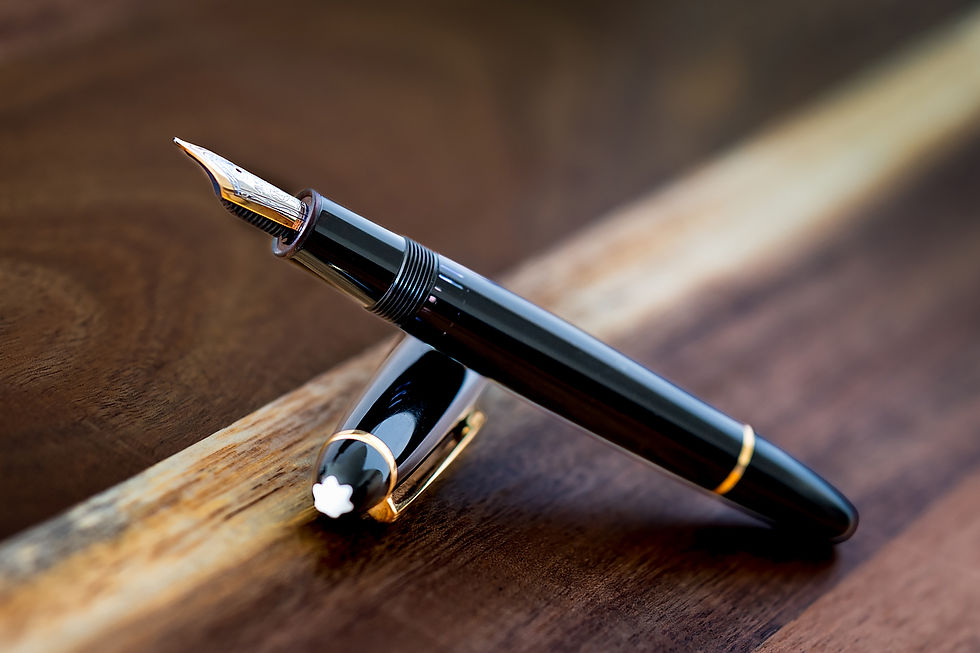
In the relatively esoteric world of fountain pens, no luxury brand enjoys wider recognition than Montblanc. Its white star—more accurately the snowcap emblem, meant to evoke the summit of Mont Blanc—is legible far beyond the circle of people who care seriously about writing instruments. Even among those who know little about pens, a Montblanc still signifies expense, seriousness, and a certain cultivated ambition. As someone who works in marketing, I can only respect that achievement. Very few companies manage to make a specialized object culturally visible at that level.
The difficulty is what usually follows such success. Montblanc has extended its name far beyond writing instruments into leather goods, luggage, watches, fragrances, and electronics. (montblanc.com) From a brand standpoint, that is understandable. From a cultural standpoint, it can feel like overextension: the conversion of a hard-earned identity into a broadly consumable luxury signal. None of this makes Montblanc’s pens bad. The Meisterstück line remains important, and in the case of the 146, genuinely excellent. But it does change the atmosphere around the object. A Montblanc fountain pen rarely arrives unaccompanied. It carries not only its own writing qualities, but the whole freight of the brand.
Pelikan, by contrast, occupies a different place in the imagination. Based in Hanover, it is far less legible as a mainstream luxury icon, yet deeply revered among people who actually write with fountain pens. That reverence has been earned. Pelikan’s history in ink and writing materials long predates the modern luxury era, and its importance in fountain-pen development is real rather than merely symbolic. The company’s name is inseparable from the differential piston-filling mechanism that became one of the decisive technical advances in the category. Hungarian engineer Theodor Kovács developed the system, and Günther Wagner, Pelikan’s parent company at the time, acquired and re-patented it in 1929. The result was not just a clever filling method, but one of the foundational architectures of the modern self-filling fountain pen. (pelikan.com)
That history matters because it points to the difference between these brands. Montblanc became a luxury emblem that also makes fountain pens. Pelikan remained, more stubbornly and more convincingly, a pen company.
The Two Pens
For this comparison, I chose the Montblanc Meisterstück 146 and the Pelikan Souverän M800. They occupy roughly the same tier in their respective ranges: both are core, continuously produced models rather than limited editions, and both sit one step below their brands’ larger flagships, the Montblanc 149 and the Pelikan M1000. The Pelikan M800 was introduced in 1987 and quickly established itself as the company’s modern full-size benchmark. The Meisterstück line, by contrast, reaches back to 1924, and the 146 has for decades been one of its central working models.
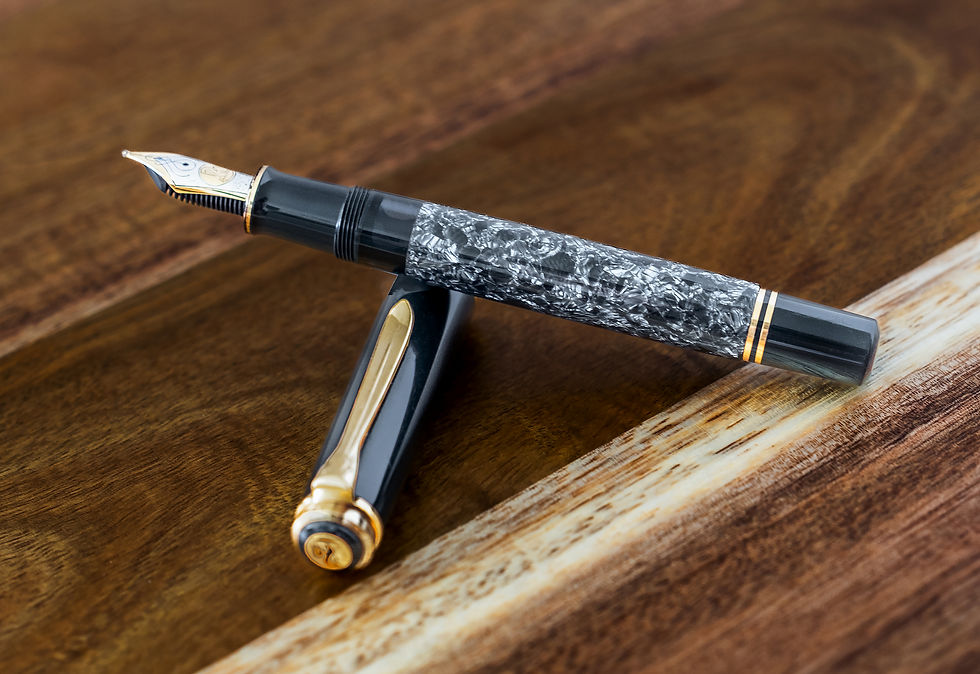
In the hand, the two pens are close enough in size to invite direct comparison. Both are what I would call full-size writers: substantial enough to feel serious, but not so large that they become ceremonial. The Montblanc follows the classical cigar-shaped idiom, rounded and continuous from finial to piston knob. The Pelikan is more architectural. Its cap top and piston knob terminate more abruptly, and the pen carries itself with slightly greater visual definition. The difference seems minor until both are on the desk together. The Montblanc reads as smooth and traditional; the Pelikan as more engineered and more explicit about function.

Nibs, Tuning, and Consistency
This is the heart of the comparison, because a fountain pen lives or dies by its nib.
The Montblanc Nib
Montblanc makes much of its nib manufacture, and not without reason. The company states that its fountain-pen nibs are crafted from solid gold in Hamburg and finished by hand. That care is visible in the best examples. A good 146 nib is graceful, generous, and deeply satisfying. My medium 146 is nicely balanced in the hand, pleasantly wet, and broader than a Japanese medium in the expected way. It lays down a confident line, and when it is on song it has exactly the sort of fluid, luxurious feel one wants from a pen at this level.
But there is a qualification, the 146 is a pen you choose individually. Its nib quality can be very good, even excellent, but it has not struck me as uniformly predictable in the way Pelikan’s better pens are, and certainly not in the way Pilot’s are. With my 146, I have experienced occasional hard starts and intermittent skipping during longer writing sessions. Not chronic failure, not disaster, but enough hesitation to prevent the pen from becoming a completely unconscious choice. In fountain-pen terms, that distinction is decisive. One can forgive a great deal in a collectible or an occasional-use pen. A daily writer has to earn a deeper kind of trust.

The Pelikan Nib
The Pelikan M800, by contrast, has been one of the most consistent modern pens in my use. I own several of them, including standard production models, a Toledo, a demonstrator, and other variations, and that accumulation is itself a form of evidence. The M800 keeps earning its place. Pelikan introduced the model with a 14-carat nib and later moved to 18-carat gold, but the larger point is not metallurgy for its own sake. It is the overall writing result. A good M800 medium is smooth, wet, and slightly more luxurious on the page than the Montblanc, not because it is softer in any dramatic sense, but because the writing sensation feels rounder and more settled. Starts are immediate. Ink delivery is generous without becoming unruly. The pen rarely suffers from the minor indignities that fountain-pen users know too well: reluctant first strokes, starved cross-strokes, or the faint sense that the pen needs coaxing before it joins you.

Pelikan’s consistency is not accidental. Its premium gold nibs are made and finished by Pelikan in Germany, then tested by hand before leaving the factory. That degree of control is increasingly rare among pen makers, many of whom now depend on outside nib suppliers or less consistent final tuning. “In-house” manufacture can be fetishized, but in this case the practical result is real: the M800 tends to arrive as a more unified instrument, with fewer surprises at the point where a fountain pen matters most.
That reliability is not glamorous, but it is central. The real test of a fine pen is not how it behaves during a minute of admiring attention. It is how it behaves on an ordinary Tuesday, halfway through a page of notes, when your mind is on the sentence rather than the instrument
Two Good Pistons, One Deeper Tradition
Both pens use piston-filling systems, and both offer substantially greater ink capacity than cartridge-converter designs. I've all but eschewed cartridge converter pens. A serious writer benefits from a pen that behaves like a self-contained tool rather than a precious object constantly asking to be refilled.

Montblanc’s piston mechanism in the 146 is excellent in the broad sense: smooth in operation, dependable, and capacious enough for regular use. But here again Pelikan has the deeper technical claim. The modern Pelikan piston stands in direct continuity with one of the category’s defining engineering solutions. The differential piston system remains one of Pelikan’s great contributions to writing culture, and in day-to-day use the M800 still feels like the more mechanically assured instrument. The filling action is precise, the capacity is ample, and the whole pen gives the impression of a design that has been refined around writing rather than around prestige. (pelikan-passion.com)
Balance, Weight, and the Feel of the Pen
Neither of these pens is poorly balanced. Both are successful full-size designs. But they distribute their weight differently, and that difference affects how they disappear—or fail to
disappear—into use.

In the Hand
The 146 is comfortable and classically poised. It sits well in the hand, and one understands immediately why it has endured. But the M800 feels more properly weighted to me. Its brass piston assembly gives it a density and center of gravity that make the pen feel especially planted during longer sessions. Some writers will prefer the slightly more buoyant elegance of the Montblanc. I do not. The Pelikan feels more settled, more exact, and more confident as a working instrument.
That impression deepens over time. The Montblanc can feel like a beautiful object one is using. The Pelikan more often feels like a pen one simply writes with.
A Personal Judgment
Writing by hand is personal, and no single pen wins on every desk for every hand. A 146 lover can make a perfectly serious case. The pen is attractive, historically important, and capable of real pleasure. It remains one of the few fountain pens that has crossed into broader cultural recognition, and there is something to be said for owning an object that has become canonical.
But if the question is not which pen is more iconic, nor which pen carries more social recognition, but which is the better writing instrument, I come down on the side of the Pelikan M800.

It is the better writer because it is the more consistent one. It is the better writer because its nib, in my experience, is less prone to hesitation. It is the better writer because its piston system feels like part of a culture of engineering rather than merely part of a luxury product. And it is the better writer because, over time, it more completely disappears into the act of writing itself.
The finest pens do not always impress most vividly at first encounter. Sometimes they simply keep showing up, keep starting, keep flowing, keep becoming part of the page rather than a performance beside it. That has been my experience with the M800. Aside from the many examples I own—which is itself a testament to how much I enjoy the model—I also own various M400s, both modern and vintage, and my beloved M1000, which remains one of my all-time favorites. Pelikan has earned that trust from me the slow way: in use.
Montblanc makes a more famous pen. Pelikan, in this comparison, makes the better one.
[Words and photography: John Giolas]


Comments